Authors: Lur Epelde, Mikel Anza, Jasmin Fetzer, Katy Jo Stanton, Josiah Judson, Nerea Mandaluniz
Journal: SOIL
DOI: https://doi.org/10.5194/soil-12-1187-2026
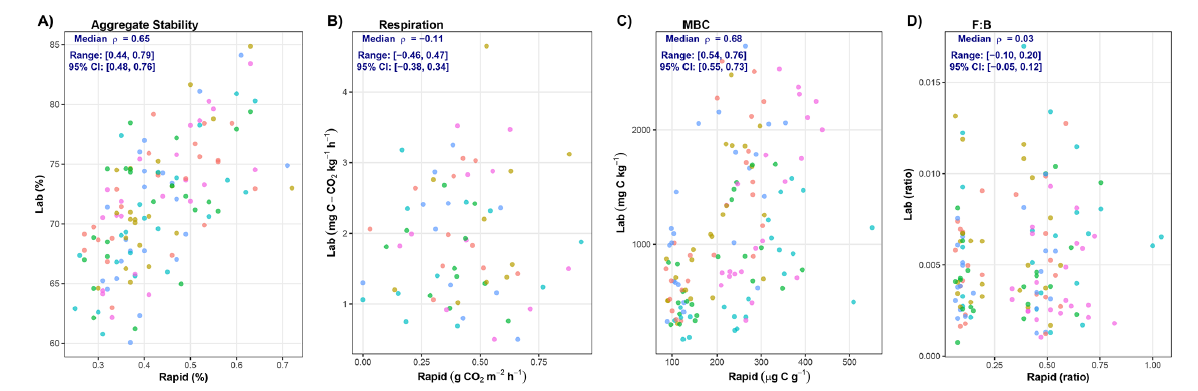
Read more: Beyond the laboratory: rank concordance of rapidmethodologies for soil health assessmentSoil health assessment increasingly relies on biological indicators because of their sensitivity and direct links to ecosystem functioning. However, conventional laboratory methods are time-consuming, require specialized infrastructure, and are often incompatible with rapid decision-making in applied contexts. Several rapid or field-deployable tools have recently been developed to address this limitation, but their ability to reproduce the relative ordering of samples obtained with laboratory methods remains insufficiently evaluated. Here, we compared four rapid approaches with their corresponding laboratory methods in a long-term grassland experiment: aggregate stability (SLAKES), soil respiration (portable CO2 analyzer), microbial biomass carbon and fungal-to-bacterial ratio (microBIOMETER®), and enzyme activities (Soil Enzymatic Activity Reader, SEAR). Rank concordance between methods was assessed using Spearman correlations, partial redundancy analyses and Procrustes analysis. Aggregate stability showed strong rank concordance between rapid and laboratory measurements (median ρ = 0.65; range: 0.44–0.79), whereas soil respiration exhibited very weak rank concordance, likely reflecting that in situ and laboratory approaches capture different aspects of respiratory activity. Microbial biomass carbon displayed strong rank concordance between methods (median ρ = 0.68; range: 0.54–0.76), while fungal-to-bacterial ratios did not. Enzyme activities measured with SEAR generally reproduced the patterns observed with laboratory assays. Multivariate analyses indicated that, overall, rapid methods captured patterns of variation associated with sampling depth that were similar to those revealed by laboratory protocols. These findings indicate that selected rapid tools can reproduce relative patterns among samples and treatments and may therefore provide useful information when laboratory facilities are unavailable or timely soil health information is required to inform management decisions.