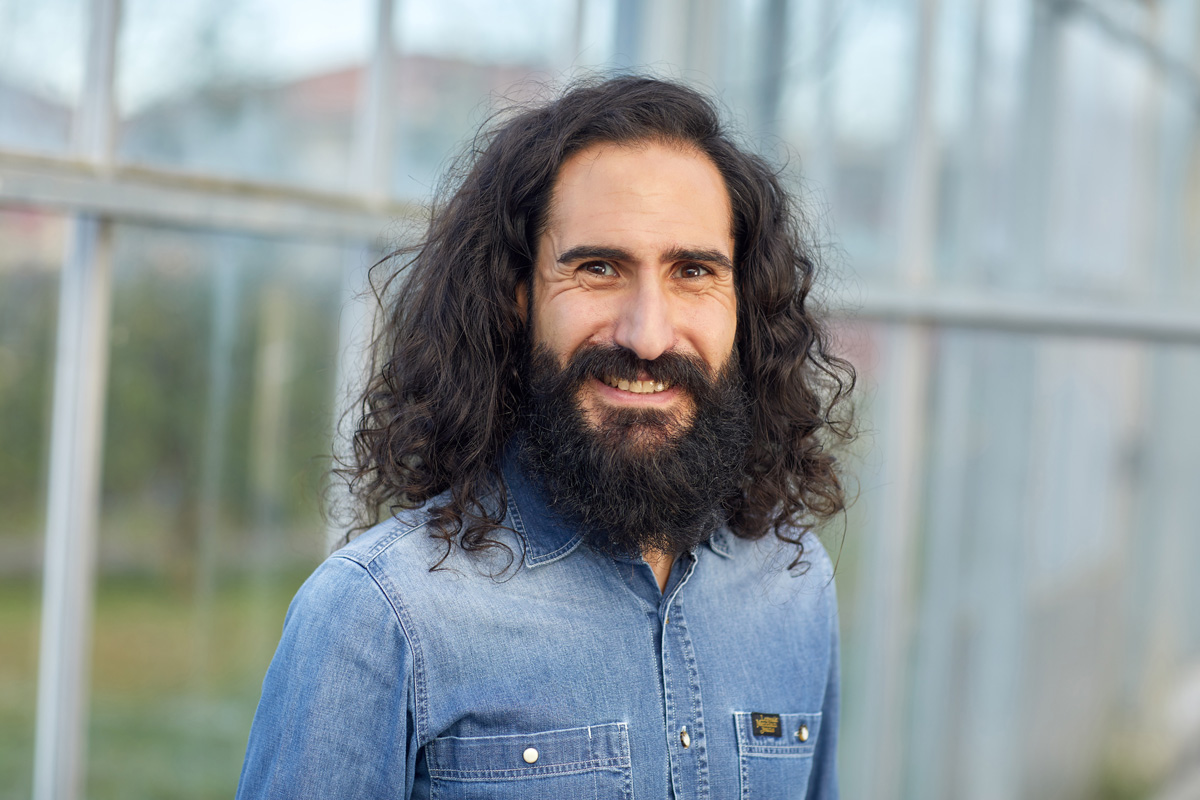
Dr. Daniel Revillini is a Researcher at NEIKER studying how sustainable transitions can promote soil health in viticulture as part of the VinAE project. More broadly, he carries out research in Soil Ecology, Sustainability, Global Change & Agroecology, always with a focus on plant-microbial interactions, mutualism and soil microbial community and function in plant stress-mitigation.
He received his PhD in Biology from Northern Arizona University (USA) exploring plant-bacterial-fungal interactions in 2018. He already had a passion (and master’s degree) for mycorrhizal fungi, which led him to develop a research line exploring plant-soil feedbacks and the influence of local adaptation on plant-microbial resource relationships.
Daniel held previous postdoctoral positions at the University of Miami (Florida, USA), The Institute of Natural Resources and Agrobiology of Sevilla (IRNAS-CSIC; Spain) and the University of Cadiz (Spain). At the University of Miami, he carried our research of rare plant communities in Florida that experience multiple forms of abiotic or biotic stress, namely fire and allelopathy. He conducted large scale field and greenhouse studies to define the role of the soil microbiome in mediating plant responses to gradients of these common natural stressors under real-world and experimental conditions. He then received an MSCA postdoctoral fellowship that brought him to Spain to work at IRNAS-CSIC and explore the variation of soil microbial functions across vineyards globally. He also experimentally tested the functional role of microbial inoculations (using whole soils sourced from vineyards) in mitigating drought impacts on early grapevine health. Most recently at UCA he was investigating the use and efficacy of microbial inoculants developed from on-farm materials in sustainable viticulture.
With a long history working in the field of molecular ecology, including experience in laboratory analyses, bioinformatics, and statistical modeling approaches with ‘big data’ that can determine effects on the microscopic-single taxa level to the global-ecosystem services level, Daniel aims to develop research within the Soil Microbial Ecology Group that applies a crop holobiont approach to agricultural systems in order to promote holistic and scalable policy decisions that transition toward the sustainable and resilient future we need.